


When Christina landed her first job through Goodwill’s Launchpad program, she didn’t just gain a paycheck. She gained confidence, independence, and a new future for herself and her family.
What many people don’t realize is that stories like Christina’s often begin with something simple: a gently used shirt or pair of shoes, a donated purse, or no longer needed household items.
Your Donations Do Double the Good
Every item you donate does more than clear space in your home. It:
- Funds job training and employment programs.
- Supports stable housing.
- Helps individuals with disabilities find meaningful work.
- Keeps usable goods out of local landfills.
At Goodwill, we say, “Your donations do good.” The truth? They do even more than that. They create opportunities that change lives!
So, What Actually Happens to Your Donated Stuff?
When you donate to Goodwill, we take great care to get the most value from each and every generous donation. Maximizing the value of your donated items maximizes the impact for Goodwill’s mission programs. The more revenue generated, the more people we can serve.
Your donations, as well as your thrifted purchases, have purpose.
Here’s how your generosity turns into real impact:
Step 1: Donations & Sorting
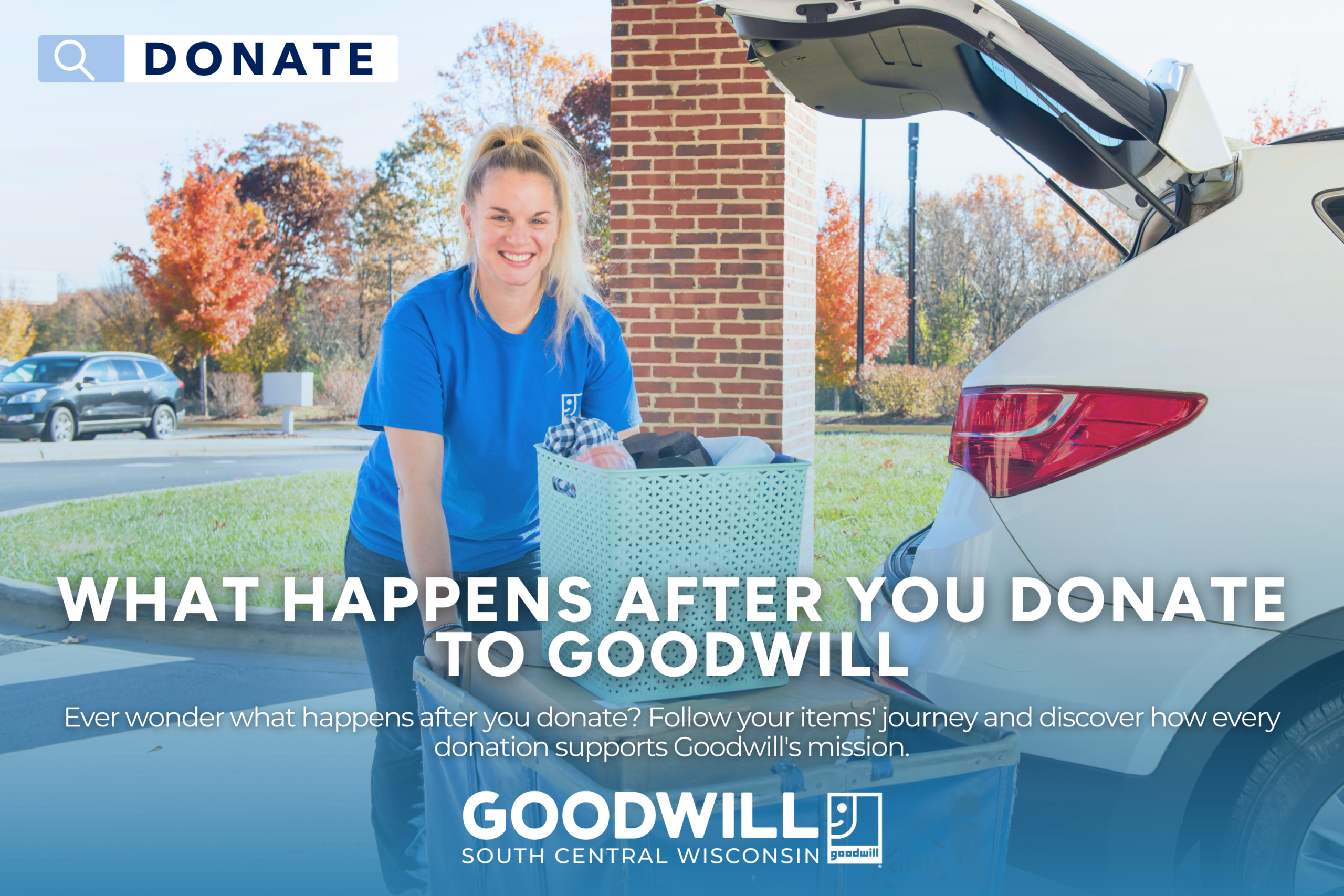
Impact begins at our donation doors. This is where Goodwill’s mission services start: when you are greeted by our Donations Team and your items are taken through the donation doors.
From there your items are:
- Sorted
- Evaluated for condition and quality
- Directed toward resale, recycling, or repurposing
Every item goes through a thorough process that includes reselling, recycling, and/or re-salvaging. Items are reviewed for their condition, quality, and resale use and value. Donations unsuitable for resale are further separated into recycling, waste, or salvage containers.
Let’s take a moment to talk about “saleable vs unsaleable” items and what do we do with items we are not able to sell.
| Saleable vs Unsaleable items
Goodwill’s goal is to give every donated item the best chance to be sold. This process maximizes value, supports the environment, and funds Goodwill’s mission. Goodwill has a way to resell, reuse, or recycle almost everything.
We ask for “gently used” donations that can sold in our stores. Sometimes we find an item with a stain or tear that can’t be sold. Instead of throwing away items we can’t sell, we send them on to our recycle partners who will make these items into other responsibly recycled materials; such as textiles that get cut up and turned into other filler materials or broken down into recycled textiles. Donated electronics in non-working condition get refurbished and are sold through an e-waste partner. Non-working large screen TVs, chipped or broken glassware, as well as paper, cardboard, metal, and plastics also all get recycled through our large network of recycling partners. Our goal is to reuse and recycle as much as possible and reduce the number of items that go into our landfills. In fact, last year alone, we diverted more than 18 million pounds from local landfills!
Second Step: Items Sold In Stores
Now, back to the items sold in our stores. Once donated items have been sorted, logged, and priced, they are sent to the store floor. “Door to store floor in 15 minutes” for a cart of hardlines (furniture, home decor, etc.) and “door to store floor in an hour” for a rack of softlines (clothing, linens, etc.) is what we aim for. Every purchase made in our stores turn donated goods into opportunities for local individuals and families.
Third Step: Items Sent to Outlet
All donated items have a “shelf life” of four weeks. If an item does not sell within this four-week period, it will be sent to the Outlet for a second chance to sell. At the Outlet, many treasures can still be found at a very affordable price. Most items at the Outlet are purchased by the pound. On average per month, 73,500 pounds of items are sold through our Outlet. That’s some 440 tons of donated items that get sold and re-used every year (which also generates more mission revenue and keeps items out of landfills)!
Fourth Step: Recycling and Re-Salvaging
After a second chance through our Outlet, items that remain are sold to salvage companies to be recycled and repurposed. With textiles being one of the fastest-growing categories in the general public’s waste stream, Goodwills across the country are continuously looking into recycling opportunities to keep items out of our landfills and help where possible for product to be resold, reused, and/or recycled.
Fifth Step: From Donation to Changed Lives
This entire process has been developed, refined, and implemented to ultimately give donated items every chance at a second life, which in turn gives others we serve in the community an opportunity to change their life.
Donations create inventory. Purchases create revenue. Together, they help transform lives.
The next time you’re cleaning a closet, downsizing a room, or replacing household items, remember: your donations do more than clear space.
- They help provide stable housing.
- They support employment opportunities.
- They keep usable goods out of local landfills.
- Most importantly, they help people in our community live, work, and thrive.
In 2025:
- More than 23.6 million pounds of items donated.
- More than 18 million pounds diverted from local landfills.
- Nearly 2,000 individuals served.
- More than 100 found stability and safe housing.
- 100+ found work through Support Employment and workforce development programs.
- 1,384 tax returns prepared for free through the Volunteer Income Tax Assistance (VITA) program.
Help even more people like Christina build better futures. Donate and shop today and help change lives, every day.